/blog/from-shodan-to-sqli
From an Exposed Service to an Unresolved SQL Injection Lead
Contents
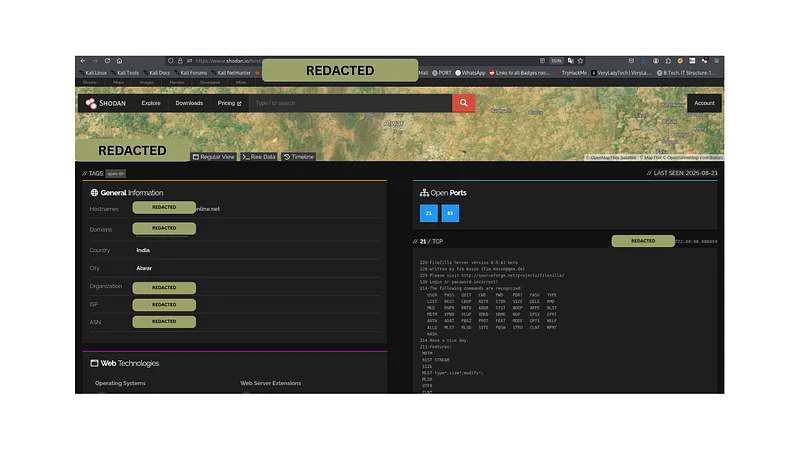
One Shodan result sent Shah Kaif and me through an Apache service, an open directory, a login form, a MySQL error, and finally an internal-looking dashboard.
That is the historical sequence. The screenshots preserve visible points along it, while the requests below are sanitized reconstructions from the old notes rather than byte-for-byte traffic. The distinction matters: an artifact can show what the browser displayed at one moment without proving authorization, backend control, data access, or the present state of the service.
1. The Shodan lead
The first signal was an indexed HTTP service with an Apache banner and an older-looking version string. Shodan was useful because it put service metadata in front of us; it did not tell us who owned the host, whether testing was authorized, whether the banner was current, or whether the application had SQL injection.
The version string was a triage clue, not the vulnerability. My early mistake was letting “old Apache” frame the rest of the investigation. Nothing retained connects that banner to the later input-handling behavior, and updating Apache alone would not repair unsafe application SQL.
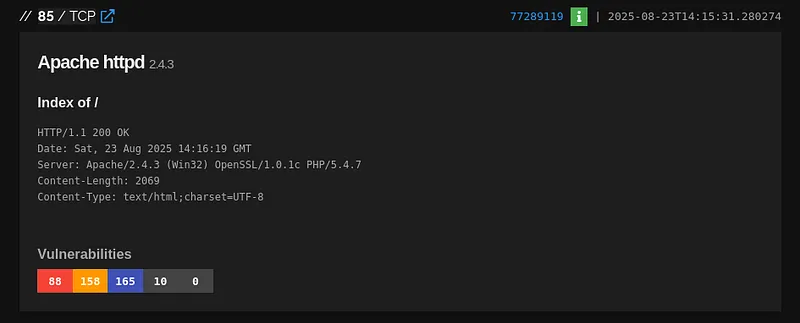
Shodan service metadata captured at the time of the investigation. The banner identified an Apache HTTP service and version string — a triage lead, not proof of ownership, authorization, patch status, exploitability, or SQL injection.
2. From the HTTP service to a directory
Opening the HTTP service rendered a directory index. Named entries and nested folders were visible, so we followed the application path rather than spraying unrelated files.
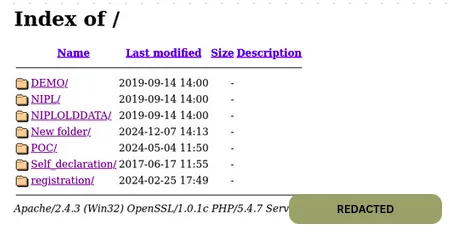
Directory listing observed after navigating to the indexed HTTP service. Named entries and nested folders were visible. This proved an exposed directory index — not sensitive-file access, database access, or that every listed path reached the login handler.
We checked several visible application directories and repeatedly landed on the same login interface. That was a useful convergence point. It was not evidence of valid credentials or a bypass.
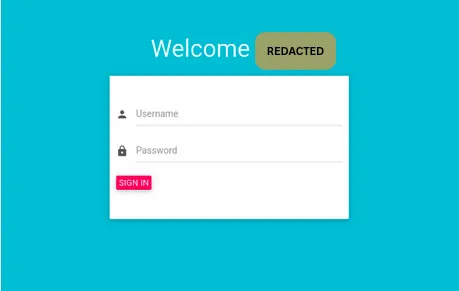
Login form reached by following the application paths from the directory listing. Its appearance established that a login interface existed on the investigated service — not valid credentials, backend technology confirmation, or authentication weakness.
3. Establishing a login baseline
Before changing syntax, the useful baseline was one ordinary failed login with controlled placeholder values:
# Sanitized reconstruction — baseline
POST /auth/login HTTP/1.1
Host: target.example
Content-Type: application/x-www-form-urlencoded
Cookie: session=[omitted]

username=admin&password=invalid-password
# Sanitized reconstruction — baseline response shape
HTTP/1.1 200 OK
Content-Type: text/html
<div class="error">Invalid username or password.</div>The exact historical path, status, cookie, and baseline body were not retained as text, so those details are representative. What matters for the comparison is that the request shape stayed fixed and only username changed.
A few guessed passwords failed and taught us nothing. Continuing to guess would only add noise and account-lockout risk, so we stopped that branch.
4. The quote variation and MySQL diagnostic
The smallest useful variation was a single quote appended to username while leaving password unchanged:
# Sanitized reconstruction — only username varies
POST /auth/login HTTP/1.1
Host: target.example
Content-Type: application/x-www-form-urlencoded
Cookie: session=[omitted]

username=admin%27&password=invalid-password
The resulting page visibly contained a database error. The old article transcribed MySQL error 1064, a CodeIgniter-style database driver location, and this query shape:
-- Sanitized reconstruction of the diagnostic query fragment
SELECT *
FROM user_login_details
WHERE user_name = 'admin''
  AND user_password = 'invalid-password'
LIMIT 1;
The doubled quote near admin'' explains why the variation was interesting: user input appeared adjacent to a quoted SQL value, and the parser complained near that location. The response also exposed a Windows/XAMPP application path and database-driver line number; those target-specific path details are omitted here because they add identification risk without improving the reasoning.
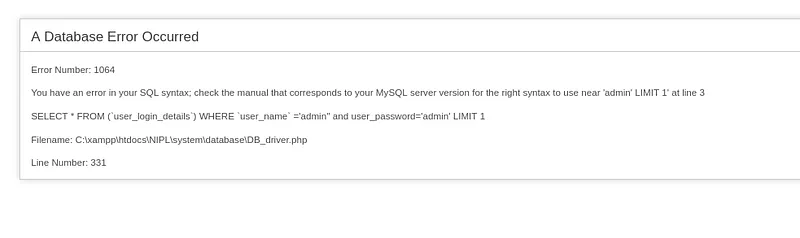
Database error returned after appending a single quote to the username field. The response visibly contained MySQL error 1064, a query fragment referencing user_login_details, and a CodeIgniter-style driver path. Server-identifying path details remain visible in this historical capture. By itself, this response does not prove repeatability, complete query control, data extraction, or authentication bypass.
This was stronger than a generic broken page because the diagnostic named MySQL, error 1064, and a query fragment involving user_login_details, user_name, and user_password. It was still only one captured response. A defensible confirmation would pair it with a repeated baseline and quote variation in explicit scope.
5. The historical payload branch
The old notes then record a compact comment-style value. The operational string is not reproduced; its inert structural shape was:
[close the quoted username value]
[append an always-true predicate node]
[mark the remaining password clause as ignored by the parser]
Its intended structure was straightforward:
- the first token would close the quoted username value;
- the next token would add a predicate intended to evaluate as true; and
- the final token would attempt to make the parser ignore the original password condition.
In structural pseudocode, the author expected the query tree to change like this:
SELECT user record
WHERE username equals [fixed account label]
  AND [predicate intended as true]
  WITH [original password condition treated as ignored]
That logic does not guarantee a bypass. It depends on query construction, whitespace and comment parsing, the existence and ordering of a matching admin row, framework behavior, and how the application establishes a session. Even a dashboard render cannot retroactively prove each assumption.
A screenshot retained from the historical sequence shows an authenticated-looking dashboard after the described submission. A second screenshot shows a distinct internal-looking panel or data view.
Dashboard rendered in the test browser after the historical payload sequence. The captured state shows an authenticated-looking application view. It does not identify the account, prove durable authentication, or establish database compromise.
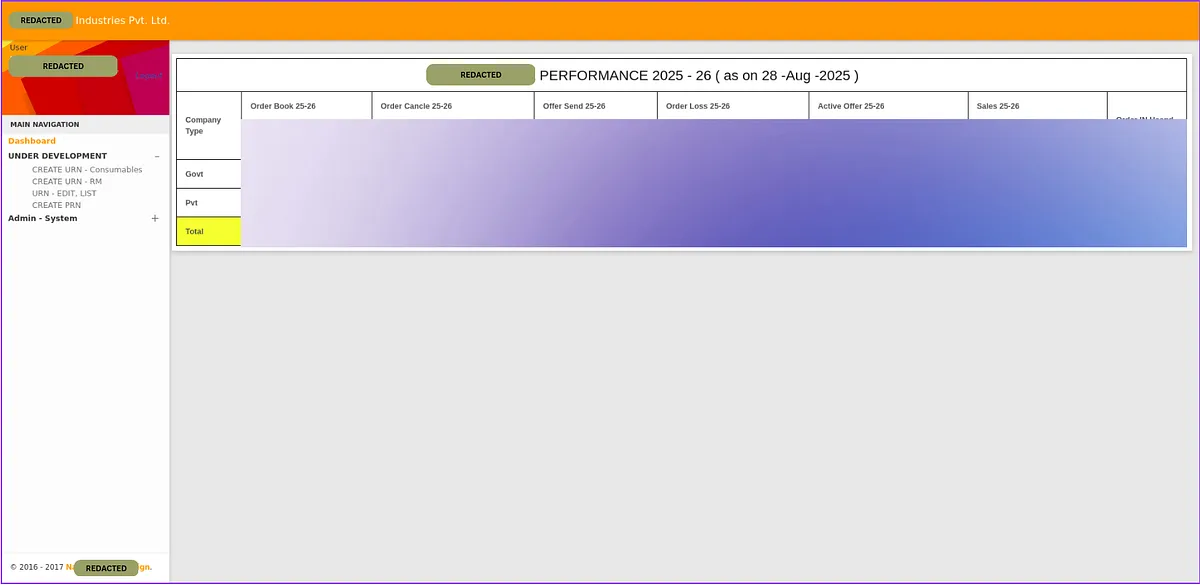
A distinct internal-looking panel or data view captured during the same test session. This shows a second application surface that rendered after the described sequence. It does not prove data exfiltration, modification, administrator privileges, persistence, or remediation.
The images establish browser states, not the missing network transition between them. Without a retained response showing a session cookie, redirect chain, and server-side authorization decision, I attribute the bypass interpretation to the historical notes rather than presenting it as independently reverified fact.
Where we stopped
Once the internal-looking view appeared, the old account says we stopped and reported the issue rather than opening records or testing adjacent functions. The retained material does not include a report receipt, acknowledgement, authorization record, remediation notice, or retest packet, so each remains unconfirmed.
I am not claiming that we extracted database rows, changed data, obtained administrator privileges, persisted access, or measured affected users. The screenshots do not support those claims, and the stop point intentionally avoided producing that evidence.
Findings that should remain separate
This sequence contained at least four observations with different fixes:
- Indexed service metadata: Shodan held a banner at one point in time.
- Directory listing: the web server exposed a navigable index.
- Verbose database diagnostics: one input variation produced a MySQL error and query details.
- Authenticated-looking UI state: the browser rendered internal-looking views after the historical payload sequence.
Only the third observation directly supports an SQL-injection lead. The fourth raises the possibility of authentication bypass, but the surviving artifacts do not bind it to a specific HTTP response or account state tightly enough to quantify access.
Remediation and regression testing
The application owner should treat the query construction as the primary code defect:
- replace string-built login SQL with prepared statements and bound parameters;
- verify passwords with a modern password-hashing API after selecting a user by a unique identifier;
- return one generic authentication failure to the client and keep database details in access-controlled logs;
- rotate exposed secrets only if review confirms that the verbose page disclosed any;
- disable directory indexes and expose only files the application must serve;
- patch supported web-server and framework versions, while recognizing that version updates do not replace the SQL fix;
- invalidate active sessions if the owner confirms unauthorized session creation; and
- review authentication logs around the captured timeframe using the privately retained indicators.
A focused regression test should submit the ordinary invalid login, the single-quote variation, reserved SQL comment characters, and long Unicode input. Every case should return the same generic failure, create no authenticated session, emit no query or filesystem path, and leave server-side records unchanged. A separate server configuration test should confirm that directory requests no longer enumerate contents.
Shodan found the door. The directory exposed the route. The quote exposed a likely unsafe query boundary. The dashboard artifacts made the historical sequence serious enough to report—but they do not license a larger story about data access than the evidence can carry.